Your First 0.001 BTC: A Short Plan for One Machine
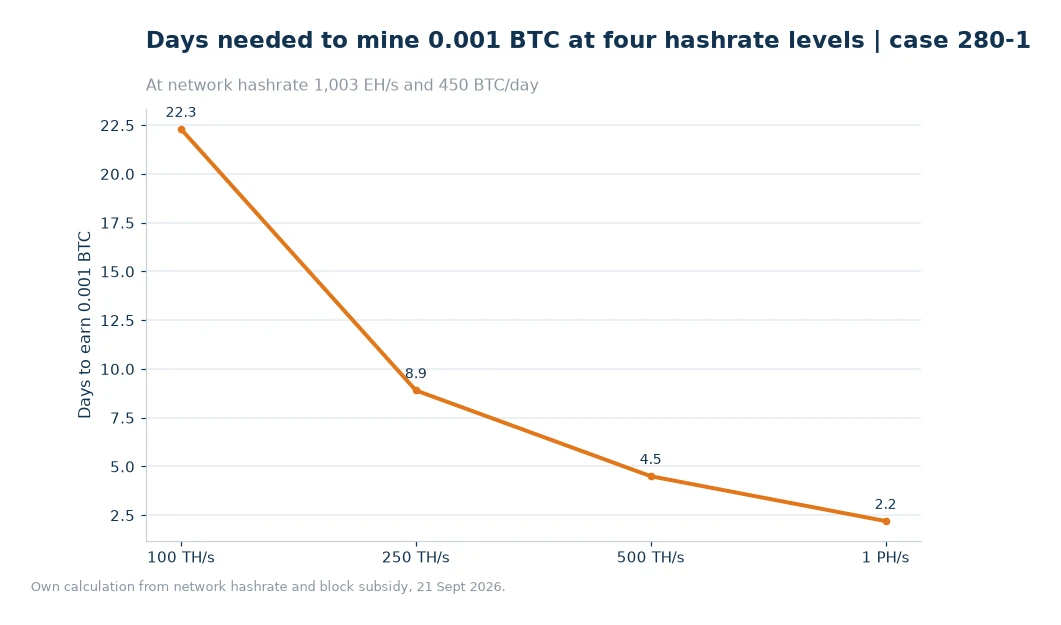
A thousandth of a bitcoin is a small goal with a useful property: it arrives quickly enough to prove the setup works. At 100 TH/s the daily credit is 0.00004486 BTC, so the target takes 22.3 days; at 1 PH/s it takes 2.2 days. That range makes 0.001 BTC a good first checkpoint for a shed with one or two machines and a lot of unanswered questions.

Key takeaways
- At 100 TH/s the daily credit is 0.00004486 BTC, so 0.001 BTC arrives in 22.3 days at continuous uptime.
- At 250 TH/s the same target takes 8.9 days, and at 500 TH/s it takes 4.5 days.
- Confirm that your own workers appear inside the Pool Hashrate figure before trusting any schedule.
- Pool Luck matters most over short windows, which is exactly the window a first-target plan covers.
A small target makes a better first test
Long-range projections are easy to write and impossible to check. A 22-day target is different: it is short enough that the result either matches the model or exposes a problem while the cause is still fresh. Treat the first thousandth of a bitcoin as a commissioning test rather than a financial milestone.
The test has three parts. The machine must report full hashrate, the pool must accept shares at the expected rate, and the balance must grow by the model each day. If all three hold for 22 days at 100 TH/s, the setup is sound and the next target can be longer. If one fails, you have found the fault before it cost a month.
Is your machine inside the Pool Hashrate?
The ViaBTC BTC Mining Pool statistics page publishes a total for the whole pool. Your contribution is a rounding error inside it, which is why the number cannot confirm that your worker is connected. What it can do is confirm that the pool itself is stable, so a shortfall on your side is not a pool-wide event.
Read the two together: the pool's reported hashrate tells you about the pool, your own worker list tells you about the machine. When the first is steady and the second shows a worker missing, the problem is local. When both drop, something outside the shed happened, and waiting is usually the correct response.
Pool Luck over days, not months
The luck figure sets the blocks a pool actually found against the number its share of network power implied. Across a month the series smooths out; over a few days it can look dramatic, particularly for a pool whose share is modest. A miner watching a three-week first-target plan will see more of that noise than a miner watching a year.
Under PPS+ the noise does not reach your balance, because the block-reward credit is settled per share at a fixed rate. Under PPLNS it does, and a short plan can therefore miss its date through no fault of the hardware. If the first target matters as a test, run it on the default scheme and switch later once the setup is proven.
| Setup | Hashrate | Daily BTC | Days to 0.001 BTC |
|---|---|---|---|
| One small unit | 100 TH/s | 0.00004486 | 22.3 |
| Two mid-size units | 250 TH/s | 0.00011215 | 8.9 |
| Four mid-size units | 500 TH/s | 0.00022430 | 4.5 |
| A small hall | 1 PH/s | 0.00044861 | 2.2 |
Note how the days column collapses. Going from one unit to four cuts the wait from 22.3 days to 4.5, which is more than the arithmetic alone suggests in practical terms: a fault found in five days is cheap, while the same fault found after three weeks has already cost a fifth of the target.
What a week of variance looks like
At 100 TH/s the expected weekly credit is about 0.00031400 BTC. In practice a week lands somewhere around that figure depending on uptime, difficulty and, under PPLNS, block discovery. The useful discipline is to compare weeks rather than days, because a day is dominated by whether the machine ran all 24 hours.
Difficulty is the slow variable. The 21 September 2026 estimate pointed at minus 2.12%, which would lift every credit slightly; a rising network would do the opposite. Neither moves a single week much, but both move a 22-day plan by a day or so, which is why the date should be treated as an estimate.
Keep the power side in the same note. At 100 TH/s the gross credit is $3.80 a day, so a 1.2 kW load at $0.09 per kWh costs $2.59 and leaves $1.21 before any fee adjustment. A useful first-target plan is not only about coins arriving; it is about the coins still being worth more than the electricity that produced them.
Build the 0.001 BTC habit
Once the first target is met, keep the same routine with a larger number. Note the date, the hashrate and the balance, and let the next checkpoint be the only thing that changes. A miner who repeats this four times has a year of records that answer almost every question about the operation without guesswork.
Withdraw or hold, but decide once. Zero-fee mining payouts mean there is no cost to moving coins out, and no reward for leaving them in beyond convenience. Either policy works; drifting between them does not, because the balance stops being comparable with the schedule.
Finally, write down what the test taught you. If the machine held full hashrate for 22 days, that is a fact worth keeping next to the purchase price. If it lost six hours in the middle, the note explains why the target arrived late and whether a fan or a network cable was responsible. Those notes are the only reliable guide to what the next machine will do.
Give the target a start date and an end date
Write both dates before the first coin arrives. The start date fixes the baseline, and the end date forces a review even if the target is missed. Without the second date, a plan that runs long becomes a plan that is quietly abandoned, and the numbers stop being a measurement of anything.
At the review, compare three figures: the coins credited, the days elapsed, and the uptime you recorded. Two of them are facts and one is an estimate, which is usually enough to explain a gap without guessing. Then set the next target from the new baseline rather than from the original hope.
Worked example
Follow the 0.001 BTC target from the network total down to the four rows of the table.
- Each terahash earns 0.00000044865 BTC a day, the 450 BTC daily issuance divided by 1.003 billion TH/s.
- At 100 TH/s: 100 × 0.00000044865 = 0.00004486 BTC a day, which is $3.80 at $84,692.
- Days to 0.001 BTC: 0.001 ÷ 0.00004486 = 22.3.
- At 250 TH/s: 0.00011215 a day, so 0.001 ÷ 0.00011215 = 8.9 days.
- At 500 TH/s: 0.00022430 a day, and 0.001 ÷ 0.00022430 = 4.5 days.
- At 1 PH/s, 1,000 TH/s: 0.00044861 a day, and 0.001 ÷ 0.00044861 = 2.2 days.
Frequently asked questions
How long does one small machine take to earn 0.001 BTC?
About 22.3 days at 100 TH/s with a daily credit of 0.00004486 BTC, assuming the machine runs continuously and the network hashrate holds at 1,003 EH/s.
Why did my first target take longer than the table says?
Uptime is the usual cause. Every hour offline removes that hour's credit, and a few short outages across three weeks can add days to the schedule.
Does Pool Luck affect a three-week plan?
Only under PPLNS, where block discovery feeds the payout directly. Under PPS+ the block-reward credit is settled per share, so short-term luck does not change the balance.
Start the clock on Monday
Write the date and the balance at the same hour, then leave the setup alone for a week. A first target is a measurement, and measurements only work if the thing being measured is not being changed while you watch it. If the 22-day figure is close, the machine and the account are doing what the arithmetic says they should.
Use the Profit Calculator to set the expected daily figure for your own hashrate and power cost, and check the pool totals when something looks off. The mobile app is enough for the daily glance, which is all a 22-day test really needs.
Sources: ViaBTC pool statistics, calculator and pricing pages[1]. Inputs on 21 Sept 2026: 1,003 EH/s network hashrate, 132.76 T difficulty, 3.125 BTC subsidy, 144 blocks a day, BTC at $84,692. Published 24 Oct 2026; dates assume continuous uptime.